
Stillwater, Minnesota is one of the oldest and most storied towns in the state. Founded in 1843 and often called the “Birthplace of Minnesota,” Stillwater rose to prominence during the great Lumber Boom of the mid-to-late nineteenth century, when vast white pine forests blanketed the St. Croix Valley and fortunes were made by men with the vision and drive to harvest them. Timber barons, mill owners, river captains, and civic leaders all left their marks on this thriving river town, and nowhere is that legacy more beautifully preserved than in its remarkable collection of historic homes. The ten homes featured here were all constructed before 1900, each a testament to the ambition and craftsmanship of Stillwater’s founding generation. And this list barely scratches the surface; Stillwater is home to dozens of historic properties, making it one of the finest destinations in the Midwest for lovers of Victorian architecture. While most of the homes are private residences, guests of the Aurora Staples Inn can stay inside a historic home.
Key Takeaways
- All ten homes were built between 1859 and 1893, during Stillwater’s most prosperous era.
- The lumber industry funded much of Stillwater’s early residential architecture, visible in the richness of the woodwork found throughout these homes.
- Architectural styles include Italianate, Queen Anne, French Second Empire, Gothic Revival, and Eastlake, often blended within a single property.
- Several homes are listed on the National Register of Historic Places, recognizing their outstanding historical and architectural significance.
- Many original families experienced dramatic rises and falls in fortune, mirroring the broader arc of the timber industry, which had largely collapsed by the early twentieth century.
- Several properties were converted to apartments in the mid-twentieth century before being lovingly restored in later decades.
Mortimer Webster House, 437 Broadway S.
Built in 1859, this home is believed to be the first Italianate-style house constructed in Stillwater. Mortimer Webster was just 23 years old when he purchased the lot, a self-described “Master Painter” who introduced a sophisticated Eastern architectural style to a frontier town still finding its footing. The property passed through many hands before Herman and Hattie Hagerman became the first owners to actually live there in the early 1900s. One of the most intriguing chapters involves Donalda Carroll, a young stenographer who lived next door, held the mortgage on the house, and eventually purchased it outright in 1910, living there for thirty years without ever marrying. The home retains its original fireplace, newel post, stairway, and the interior staircase that once led to a rooftop cupola removed in the 1870s.
Mortimer Webster House, 1021 3rd Street S.
A second property built by the same speculator around 1874, this two-story Italianate structure sits on a limestone foundation with clapboard siding and features the style’s signature low-pitched roof, widely overhanging eaves, decorative brackets and dentils, and tall, narrow windows with segmental-arched wood surrounds. Significant additions were made over the years, including a wraparound porch extending around three sides of the building between 1898 and 1904. The property changed hands frequently throughout the nineteenth century before the Seymour family acquired it in 1899 and held it through the 1940s, after which it was converted to a duplex.
Ivory and Sophia McKusick House, 504 2nd Street N.
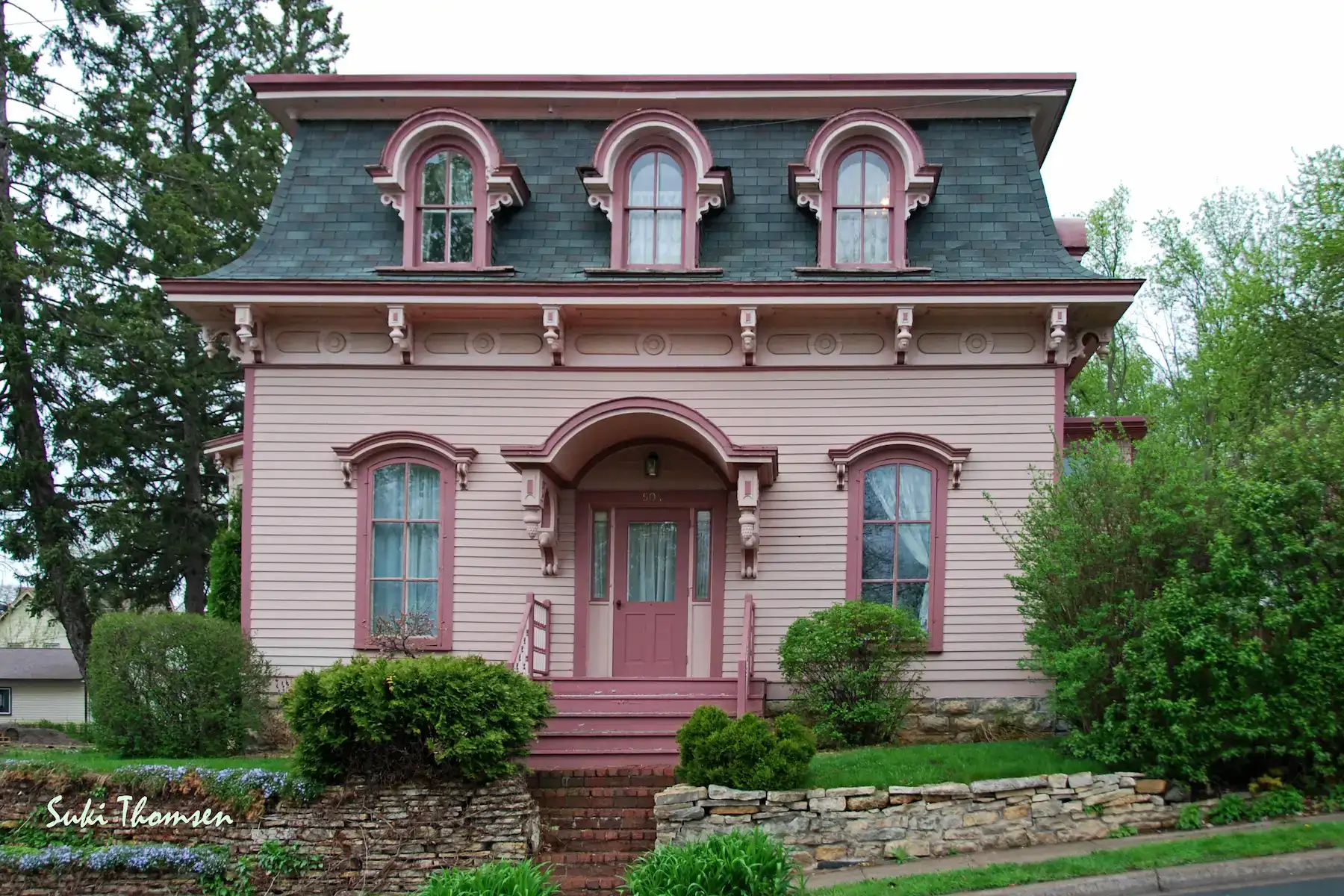
Built originally in 1866 and expanded substantially in 1872, this home is a fine example of French Second Empire style, recognizable by its dramatic mansard roof with prominent hooded dormer windows. The Stillwater Messenger covered the 1872 addition enthusiastically, describing the transformation of a “little house” into a “handsome place with a good outlook.” One of the most spectacular features is the view across the bluffs to the St. Croix Valley. Ivory McKusick built his fortune through lumbering and Civil War government supply contracts, and his brother John had established Stillwater’s first sawmill. The home is listed on the National Register of Historic Places.
Henry M. Nichols House, 208 Chestnut Street W.
Perhaps the most emotionally resonant property on this list, this Gothic Revival home was built in 1857 largely through the generosity of Reverend Henry Nichols’ congregation. Nichols’ diaries and letters, preserved at the Minnesota Historical Society, offer a remarkably intimate window into frontier life in Stillwater. Tragically, in the summer of 1860, Henry, his wife Nancy, and their thirteen-year-old son drowned in a swimming accident at Lake Calhoun in Minneapolis, leaving only their two-year-old son Willie as the sole surviving family member. The house itself is a striking example of Gothic Revival architecture, with scrolled vergeboards, steep rooflines, and “carpenter’s lace” eave detailing. The home has been in the careful stewardship of George and Kathy Schmitt since 1972.
Captain Austin and Harriet Jenks House, 504 5th Street S.
This remarkable architectural hybrid blends Italianate Tuscan Villa, American Gothic Revival, and French Second Empire elements and is listed on the National Register of Historic Places. Captain Jenks arrived in Stillwater in 1855 as a schoolteacher and gradually built a career in lumbering, riverboat construction, and civic leadership, eventually earning the Census occupation of “capitalist.” His wife Harriet was an active community hostess, and the home was known for its elaborate social gatherings. Following Jenks’ death in 1902, the house passed through several families before being divided into apartments by the 1950s and later restored as a single-family residence.
Roscoe Hersey House, 414 4th Street S.
This eighteen-room Eastlake and early Queen Anne masterpiece was built in 1879 and 1880 and is listed on the National Register of Historic Places. Roscoe Hersey was the eldest son of Samuel F. Hersey, Isaac Staples’ financial partner, and he came to Minnesota in 1867 after serving in the Civil War to manage the family’s lumbering interests. He served one term as a state senator beginning in 1878, and his home reflects the commercial success of the Hersey-Staples partnership. The house was constructed with machine-produced decorative woodwork and stands as a strong link between the St. Croix Valley and the Maine capital and personalities who helped shape its early development.
William Sauntry House, 626 4th Street N.
Among Stillwater’s grandest surviving mansions, this 28-room home was built between 1881 and 1883 and expanded dramatically in 1886 and 1902. It blends Queen Anne, Eastlake, Italianate, and Gothic elements into an exuberant architectural statement, and its interior retains parquet floors, cherry and walnut fireplaces, and notable stained glass windows. William Sauntry came to Stillwater from New Brunswick, Canada, and built his lumber fortune through partnerships and savvy investments, with his wealth eventually estimated at two million dollars. His fortune, like so many tied to the lumber industry, ultimately unraveled, and in 1914 he died by suicide at the Ryan Hotel in St. Paul. Since 1999, the home has operated as a distinguished bed and breakfast.
Albert and Helen Lammers House, 1106 2nd Street N.
Listed on the National Register of Historic Places and built in 1893, this Queen Anne home has been described as both a “carpenter’s frenzy” and an example of the “Nonsuch” style, with turrets, an elaborate entry portico, a carved sleeping porch, and roofline ornamentation drawn from Norse dragon lodge traditions. The extraordinary woodwork reflects the skill of Norwegian craftsmen and the wealth of Albert Lammers, a major logging contractor who pursued timber interests as far afield as South Carolina, Florida, and the Bahama Islands as Minnesota’s forests were depleted. The corner turret, blown off in a storm in the late 1950s, was reconstructed in 1991.
John Gieriet House, 1002 3rd Street S.
Built around 1876 for a man who ran a saloon and billiards hall on the corner of Main and Chestnut streets, this tall, narrow Italianate home features a limestone foundation, hip roof with flared eaves, and the style’s characteristic double-hung windows. By the 1890s the property had passed to Granvill W. Smith, the city’s chief of police, who by 1900 had become sheriff of Washington County. The home’s later history speaks to the evolving character of Stillwater’s neighborhoods, as the original front porch was removed sometime after 1956 and the rear addition was enlarged from one story to two.
Aurora Staples Inn, 303 4th Street N.
Built in 1892 as a gift from lumber baron Isaac Staples to his youngest daughter Aurora and her husband Adolphus Hospes, this home brings the list full circle, back to the Staples family whose name is woven throughout Stillwater’s history. Bird’s-eye maple, pine, oak, ornate inlaid flooring, leaded glass windows, pocket doors, and carved oak leaves and acorns around the fireplaces speak to the refined tastes of the era. Originally featuring a kitchen in the basement and a ballroom on the third floor, the home operates today as a bed and breakfast, and Aurora’s original dresser can still be found in the St. Croix Suite, the very room she occupied until 1924.
Taken together, these ten homes tell a story of ambition, beauty, loss, and endurance. To walk the streets of Stillwater is to walk through a living museum, where the past is woven into the wood and stone of the neighborhood itself.